A left-wing response to nationalist cultural ownership, and a vision for a broader political territory.
Denmark’s newest party is forging a unique new path to politics. De Frie Grønne is an outgrowth of the Alternative party which sought to foreground environmental concerns in Danish politics. De Frie Grønne, as the name suggests (The Independent Greens) is also centered on environmental issues and is fighting for a more environmentally focused Danish politics. Green parties are important, if generally overlooked, parties in the political spectrum. They tend to be associated with left wing positions because many of their proposals are perceived as detrimental to business. There have been recent successes for Green parties, in the 2019 EU parliamentary election The Green parliamentary group gained 22 seats and is the current 4th largest party. Green parties have also seen a swelling in support as young people across the globe have taken to the streets to protest what they see as inaction by their governments on climate change.
Green parties face particular messaging challenges that other parties don’t. Messaging can be difficult for a party that is perceived as being singularly focused, particularly if that single issue isn’t on the forefront of voters’ minds. For Green parties they must convince a population to focus on broader structural problems, to look to an existential threat that most voters probably don’t notice in their daily lives, and often, to solutions that will impact those daily lives in possibly negative ways. This is not an easy task. I think this is partly why Green parties have a difficult time establishing broader mandates (not to mention their difficulty in breaking through in first past the post systems like the United States or United Kingdom).
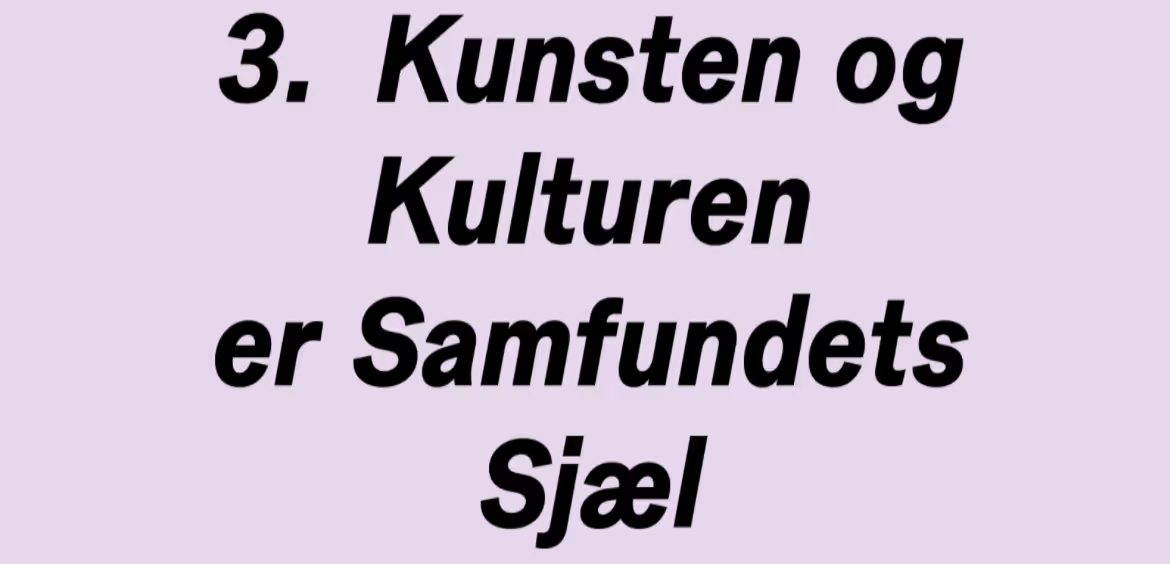
So that brings us back to De Frie Grønne. This party is new, only formally established in April of this year from three MPs from the Alternative party. De Frie Grønne’s initial political mission statement is broken into five parts: 1) Nature is Holy, 2) Diversity is Societies’ Lifeblood, 3) Art and Culture are Societies’ Soul, 4) Civil Society is Democracy’s Immune system, and 5) The Future Economy is Green, Feminist, and Democratic. For the sake of this piece I want to focus on number 3: Art and Culture are Societies’ Soul. Frankly, I don’t believe I’ve ever seen a party platform that includes art and culture as a fundamental element of political thought. And importantly, I think it holds value in the fight against anti-democratic nationalism.
From the get-go, a quick glance at their website shows that De Frie Grønne has dedicated a fair bit of headspace to this leg of their platform. While the other four legs were all published at the same time around a month ago, art and culture was added only recently. But it isn’t a simple tack-on at the end of the list. They’ve decided to nestle it just after nature and diversity. Furthermore, their political website conveniently provides a read time estimate below each leg. While the other four legs range from 5 to 9 minute reads, the art and culture section is 21 minutes. When diving into this leg of their platform, you can see why they’ve dedicated this much space: it’s a uniquely valuable approach to politics. Society is shaped by a multitude of approaches, politics, the state, local, regional, and international culture to name just a few. Oftentimes those influences overlap but equally often it’s not on purpose and can lack a sense of directionality. De Frie Grønne’s desire to mix culture and art with politics provides a directionality that is both refreshing and engaging.
De Frie Grønne breaks their conception of art and culture mixing with politics into a six part call to action. First, Denmark should have a culture law, an art and culture strategy and an analysis institute. Second, funding for cultural activities should be drastically raised. Third, more freedom for local cultural institutions. Fourth, more art and culture in the public sector. Fifth, youth culture should have a particular focus. And sixth, Danish culture should be out in the world and world culture should also be in Denmark. I won’t go into further detail on these individual directives because I think they mostly stand for themselves (although you can read the details for yourself here). What I will go into is the singular focus on blending culture with politics as a left wing party and what significance I think that can have moving forward.
When you think of culture and politics the first thought that may come to mind is a staid form or canned or protected culture oftentimes as pitched through the eyes of nationalism or conservatism. The root of many a conservative movement or party is the preservation of a flawed view of culture. Conservative parties and their more insidious cousins: Nationalist parties, take culture to be static. Not only static but immutable. Nevermind that all culture is amalgamation. Nevermind that culture is only valuable in its natural flexible form. Culture to the conservative or to the nationalist is property, property of the peoples who partake in its rigid boundaries and unflinching in the face of outsiders who may wish to take parts but not the whole. But this perversion of culture is often the one that sticks in the mind because we as humans are only allowed small glimpses during our time on earth. What we think is the “real” Danish or American culture today would be viewed as foreign to the 18th century practitioners of those cultures. Culture isn’t static and we shouldn't allow conservatives or nationalists to lay claim to what is and isn’t “real” culture. They no more get to make that determination than any other individual does.
This is why the desire to build a left-wing cultural politics is of such interest to me. As cultural revanchism and restorative nostalgia take over right-wing rhetoric (particularly as right-wing economic policy grows less and less popular) so too must left-wing political parties counter and push back on such proprietary claims. A mistake that left-wing groups make is to counter national conservative claims of culture with a bland or not--fully-flushed-out multicultural focus. Instead, they should focus on the truth that their own national culture is already multicultural which is part of the reason that culture is so rich. Danish meatballs (frikadelle) are probably of Turkish origin, but that doesn’t mean they aren’t Danish. American values stem from ancient Greece and Rome through Western European scholars from the renaissance and forward, but that doesn’t make them un-American. A shared story shouldn't diminish a national identity, it should only strengthen it. Conservative thinkers like the late Roger Scruton argued that multiculturalism is the downfall of civilization. That the muddying of cultures into a giant mash will strip the world of all that is good and unique. But that simply doesn’t bear out. While we now, in the 21st century, are more interconnected than ever before, that doesn’t mean that cultures weren’t already mixing and adapting since society's inception. The mixing of cultures is not like the mixing of paints. Cultural conservatives would have you think that doing so results in a muddied brown hue while the reality is a multitude of colors with new shades and hues created from the mix.
Economic incentivization has often come at the cost of cultural growth. Where once culture and art were viewed inseparably valuable to societies, our modern capitalistic culture has overtaken our conception of value. Value is whatever we can sell; whatever can make a buck. Some progressive economists like Mariana Mazzucato have fought back on this definition. As global unrest rises along with depression it may be time to take new approaches to such long held concepts like global economy, value, and politics. De Frie Grønne provides one possible alternative to the standard order of things. A politics that seeks to expand and enrich public life through non-purely economic means. Denmark is a ripe place for this type of politics. Already one of the freest and fairest countries due to it’s expansive welfare state. Yet Denmark’s national politics are still dragged down by economic policies, thoroughly depressing nationalist dog-whistles, and performative politics. De Frie Grønne’s culture and art initiative could be the start of an exciting time in which the most fiercely activating political subjects get a left-wing champion. I look forward to watching where this party goes from here. They currently have three members in the Folketing but still have to establish themselves via voter support because those three were originally elected from a previous party. I believe that, with the proper outreach, their message is the kind of unique political message that has been lacking among left-wing parties in the last several decades and could lead to some real movement and support as they proceed.
(Note: an earlier version labeled De Frie Grønne in English as "The Free Greens" which I've now changed to their preferred translation "The Independent Greens")