Anti-democratic for whom?
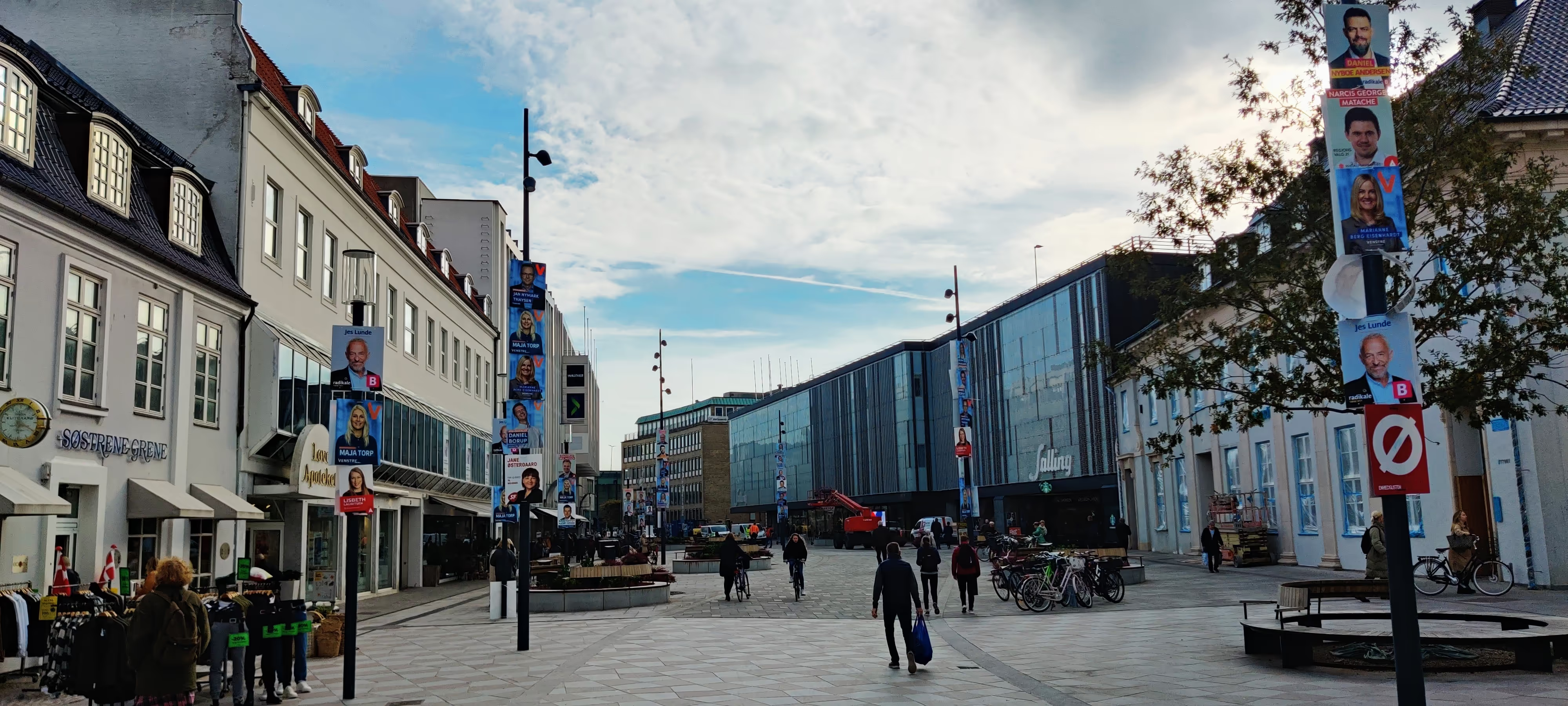
Over the weekend, the period of political advertisements officially kicked off for the 2021 regional and local elections. Parties and candidates rushed to bespeckle every lamppost and public fence with placards beaming their smiling faces. It’s standard fair for every Danish election, a little over a month out, the candidates, desperately fighting for name recognition among a sea of viable candidates, hope that seeing their face every time you drive to work or take the bus to the grocery store will be enough to set a cross by their name when you step into the ballot box. From an American perspective, it’s a fascinating difference in campaigning. In the US, candidates are only allowed to put their signage up on private property with the permission of the property owner. This leads to the ubiquitous yard sign, or occasionally, a large sign at the end of a field or building. The inclusion of the face makes the Danish placard more personal, add in that they are allowed on all public spaces, and they are impossible to avoid. These placards are so ubiquitous that it was a news story that one of the parties in a single local area decided NOT to use them.
Vandalism of placards are rare so when it does happen it raises an audible hubbub. Just as the signs were raised over the weekend, one candidate was targeted with Nazi symbols, including swastikas and SS markings on their placards. This has raised concern among the politically activated on Danish twitter. Commentators from left, right, and center abhorred the vandalism and foreshadowed a weakening of Danish democracy. Nearly all labeled the act “anti-democratic.” The argument, seemingly, holds that a weakening political discourse, the inability to argue against this candidate's words with words of one’s own, spells a worsening political climate in Denmark.
While vandalism is not the most acceptable form of political speech, it is, in fact, speech. Now, obviously most countries have decided that vandalism is not a legally acceptable form of speech, and the crude drawings on this candidate's placards certainly can not be construed as well formulated and thought-through speech, however they do represent some members of societies’ views of this candidate or his party. It is worth looking at who the candidate is and what party he represents. Christian Bülow is the vice-leader of the Danish People Party’s youth organization and is currently running for the equivalent of city council in Frederiksberg, a suburb of Copenhagen. His record is not that of a Nazi by any means, his primary political concerns have been trying to dramatically reduce the budget of DR, Denmark’s public tv and radio organization. But he is also the campaign chief for the adult party’s vice-leader, Morten Messershmidt. I’ve written about Messershmidt before. His political program is built on jingoistic nationalism and religious exclusion. He has been convicted of racism by the state and stole money from the European Union while in office as a member of the European Parliament. The latter charge has him set to serve half a year in prison, although he has appealed the verdict.
The question of anti-democratic behavior is unfortunately rarely leveled on parties themselves in Denmark. Once a party has passed the electoral threshold necessary to seat members in parliament those parties become seemingly democratically protected. Elected by democratic means, to question the democratic credentials of those parties is, if not out of bounds, at least not seriously engaged with. This is deeply troubling. A party like the Danish People’s Party advocates for exclusionary and definitionally anti-democratic policies. They have also managed to transform Danish politics in such a way that few parties dare to advocate for a more just and fair immigration system. The resulting laws enacted by this “paradigm shift” has led to Denmark losing ground in various global democracy indices even as the country maintains high rankings across the board.
The members of Danish society least able to give political voice to their concerns are the exact people whom parties like the Danish People’s Party legislate against. Immigrants and their children have few routes to real democratic engagement. Children born in Denmark, raised speaking Danish, attending Danish institutions, and engaging with Danish culture and traditions are not citizens if their parents are immigrants. This means there is a small but important segment of Danish society who are fully integrated by almost any measure but are locked out of the political system unless they go through the citizenship process. Add to this the recent laws passed which make it more difficult to obtain citizenship, and you have a dangerous recipe for anti-democratic forces. In order to obtain naturalization, one must have worked full-time for three and a half of the last four years, this doesn’t include education. Therefore, the children of immigrants must make decisions that can set them back economically, by delaying higher education in favor of lower paid work, in order to obtain basic political rights. Furthermore, a recent law bars the granting of citizenship to any non-citizen who has partaken in any crime in the past. Therefore the petty mistakes of a teenager can be held against the adults ability to ever partake in their only known political system. Finally, naturalization requires a full vote by the entire Folketing (parliament). While a political majority against naturalization has yet to materialize, the Danish People’s Party regularly votes against any and all naturalization of citizens whenever the process comes before the chamber.
As a result, those who are more directly affected by the anti-democratic nature of far-right parties in Denmark have the least political voice to act against these groups. So it’s not altogether surprising that members of the party would be confronted with vandalism and property harassment. Not that it makes these actions acceptable. I broadly agree with the critique that this form of vandalism protendes negative future discourse. But, it’s not because I see the vandalism as some evil unto itself, rather, I think it’s clear that the political environment constructed by the Danish People’s Party is just as, if not more, responsible for democratic backsliding on discourse. When vulnerable members of society are not granted the same democratic rights as others, then democracy is already weakened.
Obviously, I can’t say for sure who vandalized Bülow’s placards and the likelihood that it was a citizen with full voting rights is just as likely, if not more so, than if it was someone shutout from the voting process. Regardless, there can be little doubt that the act was political speech. What that means for Danish democracy is indeed negative. However, the act alone should not be viewed in abstraction. The targeting of this party in particular with Nazi iconography should not just be viewed as some random bit of vandalism but should cause political commentators to take more seriously the anti-immigrant and exclusionary policies and statements from parties like the Danish People’s Party.
Democracy is a practice not a destination. While Denmark currently has one of the strongest democracies in the world, that does not mean that it is perfect or that it is invulnerable to democratic backsliding or decay. Addressing the inequities in representation would go a long way towards minimizing the impacts of far-right, xenophobic, and exclusionary parties. Afterall, it’s much easier to target and demonize sections of the population who do not have the ability to vote than those that do. The lack of birth-right citizenship and the difficulty of obtaining citizenship in Denmark are both things that ought to be addressed before expending excessive political energy on how inappropriate it is for a political placard to be vandalized.
Political speech can be caustic, violent, and down-right ugly. Those are often signs of deep divisions in a society. Addressing root causes is difficult but ultimately far more effective than simply chastising the speakers. American politics have devolved into negative campaigns where politicians are elected more often because their voters hate the alternative more than they love the person they are voting for. I can understand why Denmark sees examples of American politicing and shudders. No country should desire such divisions. But to turn a blind eye towards the behavior of politicians and parties themselves and chastise those members of society who feel left out or punished will not make negative speech disappear, it will only make it more likely.