Coronavirus and the future for far-right parties.
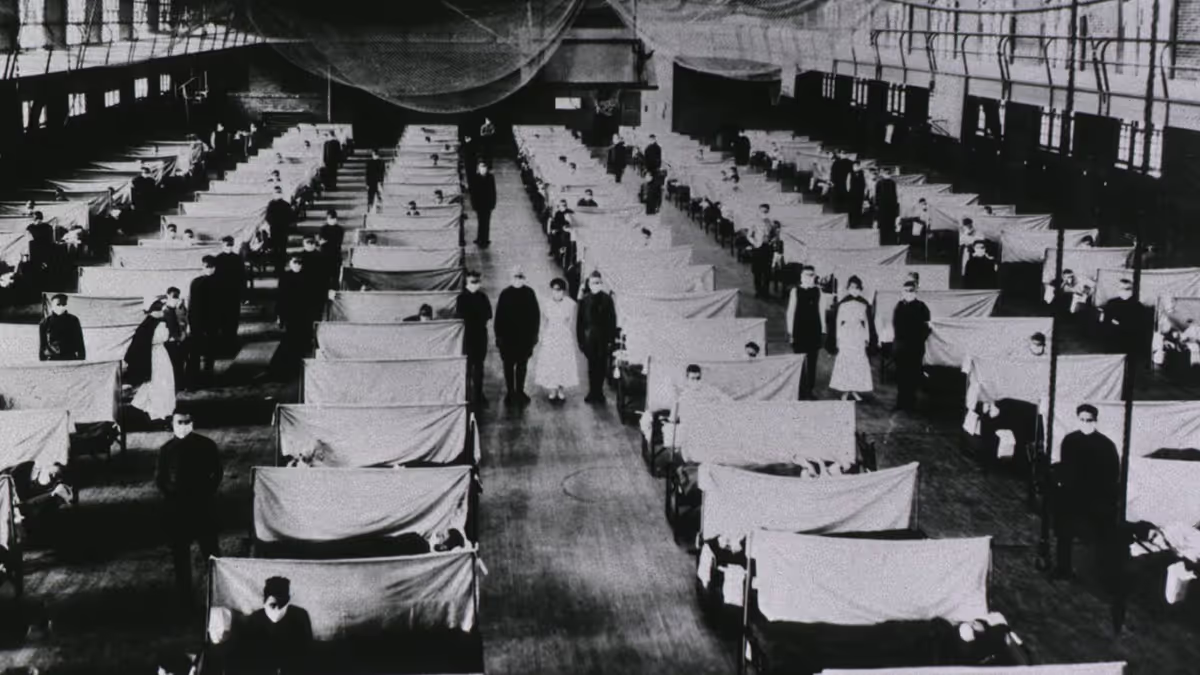
The coronavirus is sure to change the world. Already, businesses have adapted (or gone under), politicians have surged in popularity (or crashed in flames), and cultures have adapted to a less social, less intimate realty. With a few vaccines just around the corner, I think it may be a useful time to think about some of the less noticeable ways in which the virus has inalterably shifted the social, economic, and political landscapes. Because it’s the political subject I just can't get out of my mind, I’m going to start with how coronavirus has impacted far-right and nationalist politics.
Nationalist and far-right parties saw a bit of a renaissance in the mid-teens. In Europe, the influx of refugees and immigrants from the Middle East and North Africa spurred nationalist parties into positions of influence and pushed the UK to leave the European Union on the back of agitation from the United Kingdom Independence Party (UKIP). In the United States, Donald Trump won the presidency by preaching against Islam and South American migrants and asylum seekers. His presidency was born from years of the ‘War on Terror’ which legitimized anti-Muslim sentiments in the name of national security, and the activation of white identity politics following the first black president in Barack Obama. In India, Narendra Modi’s Hindu nationalist party gained power on the back of deep divisions between Hindu and Muslim peoples in the largest democracy in the world. In Israel, Benjamin Netanyahu used his relationship with Jewish nationalist coalition partners as well as American president Donald Trump to signal a form of far-right nationalism even as his party's platform remained closer to the center.
Much of the nationalist surge has been driven along with the help of a right-wing media apparatus that creates, spreads, and popularizes nationalist positions through the use of outrage media. Social media has been a particular boon for the nationalist cause. Julius Krein, founder of the right wing populous journal American Affairs, noted his conversations with European nationalist politicians as being more about what draws anger on social media than on what policies they actually want to see implemented. In fact, there have been several examples of European nationalist parties that are more bark than bite. In Denmark, the nationalist Danish People's Party (Dansk Folkeparti) won the second most votes in the 2015 parliamentary election but refused to form a government and operated instead as the veto player for the much weaker center-right coalition that formed in its stead. Likewise, in Germany, the Alternative for Germany party (AfD) became the third largest party in the Bundestag in 2017 after having never sat members before. However, to this point, they have failed to seat a member in the Presidium (which serves as the leadership of the chamber) and several elected members of the party have left after being seated.
Corona Virus has further presented internal issues for nationalist parties. The media sphere which helped propel far-right and nationalist ideas is now at the root of virus conspiracy making. Nationalist parties are being forced to grapple with their own members acting as the chief spreaders of viral misinformation. This has forced the Republican party in the United States to delicately dance between enacting important prevention measures at the state level while also giving signals to their voters that the virus is not as dangerous as their precautions suggest they are. Republican governors who have been proactive against the virus will likely face primary opponents in coming elections. In Ohio, Republicans legislators drew up Articles of Impeachment against their own Governor, Mike DeWine, because of his proactive approach to the virus. In Denmark, the Danish People’s Party has lost ground in opinion polling to the more virulently nationalist New Right party and has increasingly been torn between members of its party who want to see more fight against the current center-left government even as its members of parliament have been mostly complimentary in their support throughout the crisis. Alternative for Germany just encountered a virus split at their national party meeting this week when the leader of the party, Jörg Meuthen, shouted down a crowd demanding action against what they viewed as Angela Merkel’s ‘Dictatorship.’ His renunciation of that position led to discontent and a party that seems close to splintering.
The difficulty of riding political waves that rely on outrage media and a loose connection to factual reality, is that it can be hard to use your acquired political power. This strategy is one of flying too close to the sun. While it may be useful to spread outrage and fan the flames of anger to gain political standing and win over voters, it’s a detriment to the actual sloppy contours of democratic governance. The epistemic sphere crafted by and for the nationalist politicians do them few favors when they must face the actual structural and legal frameworks that make their style of policy change difficult to achieve. While I don’t see coronavirus being a death knell for nationalist far-right parties, I do think the global crisis will create separations and splinter previously coaligned groups. No doubt there is a desire for this type of populist right, but as that desire moves further from political realities it will become harder and harder for these parties to maintain the careful balance between their jobs as legislators and their jobs as political operatives.
The next phase of our corona adventure is the approval and rollout of vaccines and it may be the most contentious portion of this saga. Anti-vaccine movements have gained ground among western audiences for the past two decades, and the current climate around the vaccine has already launched a host of conspiracies about what the vaccine is REALLY intended to do. Furthermore, many people have genuine concerns about the speed and spread of the final vaccines. With the virus on the popular consciousness I expect far-right parties to be forced by their constituents to respond in some form or fashion to the vaccine rollout. Whether they accept the position of their most conspiratorial minded voters or err on the side of medical expertise, they will be placed between the rock of scientific evidence and hard place of political support.