Nationalists, Populists, and Identitarianism.
The resurgence of nationalism in the populist far-right across the West has led many on the left and center-left (and even center-right) to wonder how they can stem this seemingly popular tide. If left unchecked, the populist tactics can sweep up the nation and lead to the elections of dangerous politicians like Donald Trump or Jair Bolsonaro. Yet the messages preached by these politicians combine two strains of political thinking that are quite powerful. 1) Elites are robbing us of our rightful place in society, we must rise up and take back the power of OUR nation, and 2) we are the real Americans, Brazilians, Danes, Germans, Indians, ect..
At the heart of these political movements is the skillful use of fear and threat. Populists and nationalists would have little room for support if they didn’t play on the insecurities of their voters. The message of taking back the state from elites only gets play if a significant portion of the population can be convinced that the state really is being run by elites against the common folks’ best interest. Likewise, it is difficult to motivate voters based on their membership in a select nation if those voters don’t feel like that group is under threat.
The introduction of useful and nefarious others is at the root successful populist and nationalist messaging. Elites, be they political, financial, industry, media, or even local; or Others: immigrants, Blacks, Jews, Muslims, asylum seekers, refugees, are the most necessary component for a populist or nationalist. They provide the enemy; the threat at the gates, or worse, just next door. Populists and nationalists have no political leg to stand on without comparisons to what they are not. They are fundamentally identitarian political movements, grounded in who is, and isn’t, a part of the in-group.
As a result, both of these political movements are grounded in dependency. They are dependent on the strategic use, and continued existence of the Other. This is why, even after winning election and becoming technically “elite,” populist politicians continue to cast their derision towards ever harder to define centers of power. Donald Trump ran on draining the swamp but never did much to change the actual governmental apparatus in Washington. Instead, he redirected his derision of the elites towards the “deep state” a term used to give shadowy intent to the massive and varied bureaucracies of the executive branch. Obviously, this construction was always a bit difficult to square. If Trump was being stymied by the deep state then why didn’t he do anything about it? After all, these agencies exist directly under the leadership of the president which Trump was for four years.
But this is exactly the reason why populism and nationalism blend together so well. If Trump ran simply as a populist, his time in office and failure to get around the power of elites and the deep state would be considered a resounding failure. But, combine this with nationalism, and there is always a dangerous target to pivot towards.
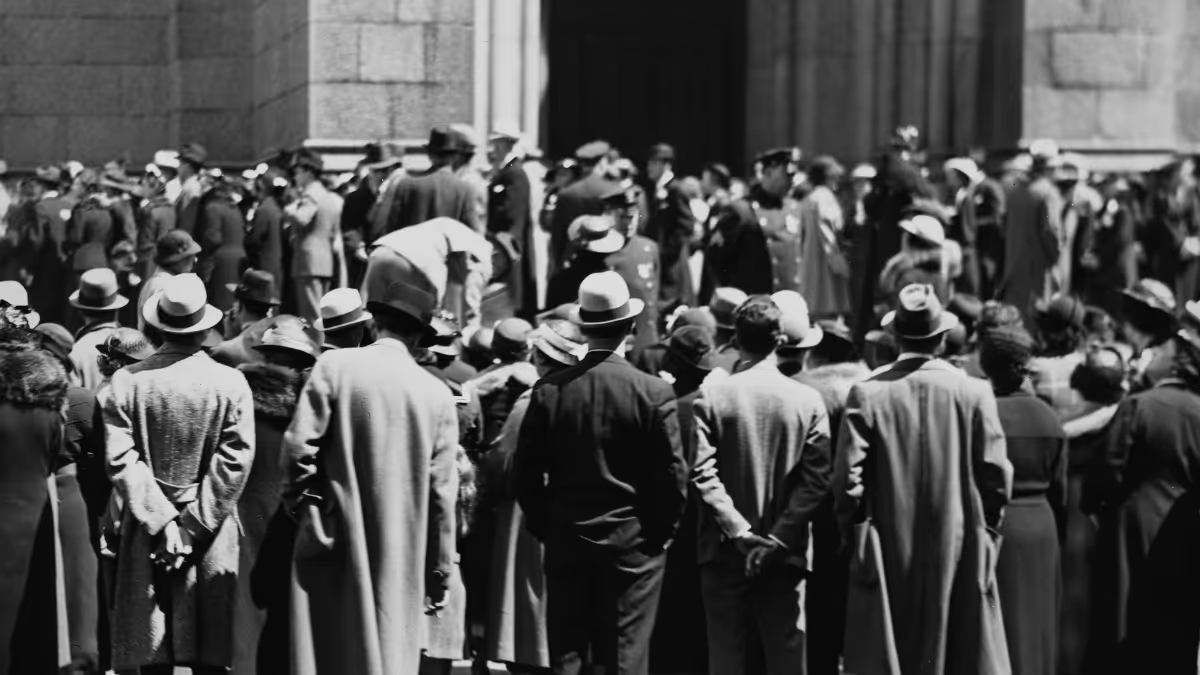
Nationalists attempt to project strength. At their most extreme, they march in the street and commit mob violence towards those they consider ‘outside’ the nation. In office, they make bullying addresses, shout down colleagues, deride the opposition, and cajole their followers. But that projection shows their incredible weakness. If you listen to the nationalist, you’d believe that a mosque just down the road is actually a factory for terrorism. If you listen to the nationalist, you’d know that your financial troubles are not a mixture of personal turmoil and systemic failure but actually the nefarious workings of Jews in the financial sector. If you listen to the nationalist, your toddlers enjoying some snacks and decorations at their kindergarten on Eid is actually the Islamification and end of our people as we know them.
Nationalism and populism inhabit fragile spaces, it’s the only way for these ideologies to gain traction. They pray on the most basic human instincts: threat and it’s resulting fear, resentment and it's resulting anger. Instead of bridging gaps and forming coalitions, these isms use division and ever lingering threats to drive political support. They are programs with no attainable goals. The modern state has never been without elites. Even when so-called populists topple the regime and establish their control, they really just transfer elite status from one group to another. When nationalists purge the nation of all outsiders they must find ever further groups to demonize, those who were once a part of the nation are recast as outsiders.
At the heart of both movements is a lack of recognition that reality is more fluid than it appears. Today’s elites could be tomorrow’s beggars. The nation as we know it today bears only fleeting semblance to the nation of 200 years prior. The nationalists of the 19th century would look down at the nationalists of the 21st century with disgust and misapprehension. Which is part of the reason why nationalist thinking is so convoluted. Often nationalists are harkening to a previous era, a pure era for the nation. But those nostalgias are necessarily fragmented and incomplete. The golden age that has come and gone was probably not recognized as golden to those who lived it. Some golden age denizens surely looked back further in the history and lamented with rosy nostalgia some by-gone era.
To be a nationalist is to assume that all change and all outsiders are threats. It’s the most extreme conception of conservatism there is. Nothing can change because every change brings about the end of life as we know it. The nationalist wants nothing more than to freeze time in a place it’s never actually been. This is why I believe most nationalist politicians are actually just political power seekers. They known better and recognize that the ideology they espouse has no real end goal. The posts will always move. However, they also recognize how powerful threat and resentment can be for winning over voters. These politicians gain power and operate in the same corrupt fashion they profess to abhor.
Playing off threat is useful, it’s why every right-wing party and even the governing center-left Social Democrats right here in Denmark have adopted nationalist thinking and policy into their platform. While the strategy may work to hold off the power of the true nationalist right-wing parties, I think it’s a dangerous concession of political territory to an untenable, ideologically driven position. The Social Democrats, having used nationalism to their advantage, may come to regret the mainlining of threat into the Danish veins, or they may continue to use it as a means of building a lasting political dynasty. Feeling no regret and pushing remorse to the furthest reaches of their inner monologue.
Nationalism and Populism don’t appear to be going away. The scare of the late 10s has brought about some calm in the early 20s, but there has been no resurgence of ‘status quo,’ center-right, center-left politics in the democratic world. Populist and nationalist leaders continue to use identitarian divides to bring voters to the polls and to maintain political power. Likewise, non-nationalist/populist parties have adopted similar strategies to get and hold power like the Social Democrats here or Emmanuel Macron’s rightward pivot in France.
What all this signals, along with other political trends, is the centering of identitarian politics across democratic (and undemocratic) spaces. One could argue that politics always has been and always will be identitarian. But I think it’s clear that this era, fueled by the instant access of social media, is something more direct than previous conceptions. The term “identity politics” is often lobbed around as a political diss. However, perhaps we are just coming to better understand how political behavior is shaped by who we are, how we perceive ourselves, and how others perceive us. How we can use this realization to pull democracy back from the brinks of sharp polarization, political discrimination, or even political violence is yet unclear.
Recognizing that identity drives politics may help us better combat it’s most extreme excesses. If we are able to name-and-shame populists and nationalists as identity exploiters and political grifters it may help stem their popularity. Or, we may simply be entering an era in which identity and political viewpoints march hand-in-hand. Where political affiliation can be gauged on first appearances. In some circumstances we’re already here.