On the kerfuffle over “defund the police”
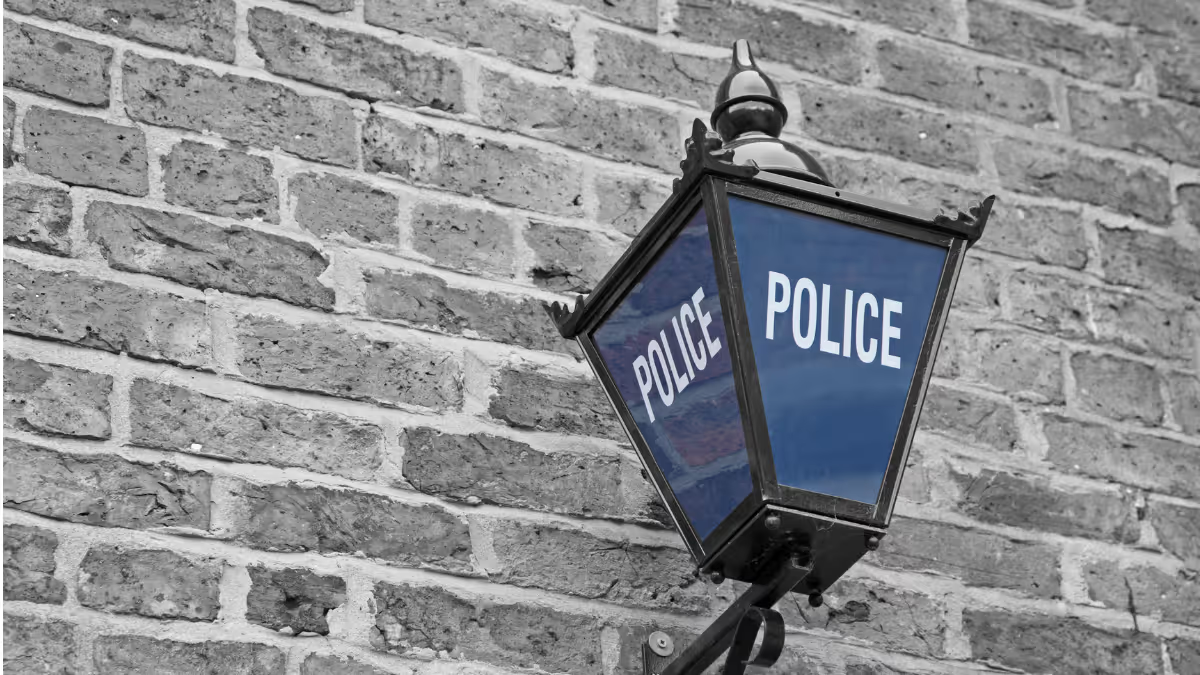
Former President Barack Obama rattled the proverbial hornet's nest on Tuesday. Appearing on Peter Hamby’s Snapchat series “Good Luck America,” Obama said the following when asked about his advice to activists who use the phrase ‘Defund the Police’:
"If you believe, as I do, that we should be able to reform the criminal justice system so that it's not biased and treats everybody fairly, I guess you can use a snappy slogan like 'Defund The Police,' but, you know, you lost a big audience the minute you say it, which makes it a lot less likely that you're actually going to get the changes you want done."
His statement drew rebuke from progressive activists across social media as well as politicians. Representative Ilhan Omar (MN-5) responded:
https://twitter.com/IlhanMN/status/1333946901868195840?s=20
Obama’s statement, on its face, is rather innocuous. But he’s diving into an already thorny arena. He’s making an argument that political sloganeering is a careful game, and when you want to see real change you need to play the game even more carefully. The responses to his claims rightly point to the difference between the role of the politician and the role of the activist.
The politician’s job is to get elected, and move forward legislation. This requires a delicate touch and aversion to controversy (at least in our first-past-the-post system). The activist’s job is to forward a viewpoint, oftentimes a deeply unpopular or controversial viewpoint. The activist to politican relationship is always one of testing, compromise, and distancing. A politician waits for the views of the activist to gather support and find mainstream voices so they too can ride the coattails to electoral victory and possible legislation. More often than not, activist positioning never makes it into the mainstream and gets lost to time (or adapts and is accepted). However, the activist also plays the important role of pushing the boundaries of accepted political speech, turning the unthinkable into the thinkable and the impossible into possible.
While activism and activists have been studied, the nexus between activists and politicians has not been thoroughly studied. As a result, we don’t have any body or research or specific theories from which to glean information from for our current moment. However there are some peculiarities to the American system which may make this current moment different from previous examples of activism spurring political change. For one, the polarization of the United States is more intense than it has been for over a century. The difference between the two parties couldn’t be more stark. Furthermore, the composition of both parties makes for an even more precarious form of polarization. Where you live, what you worship (or don’t), what your race or ethnicity is, and even where you shop, are increasingly determinative of what party you vote for. Also, the parties are coalitionaly very diverse from each other. The Republican party is mostly the party of White conservatives, while the Democratic party is more of a large tent with fractions ranging from older, more conservative Blacks and Latinos to rural White laborers to urban racially diverse progressives.
This radical divergence between the two parties is exacerbated by our outmoded political rules. As the two parties have moved further from each other, they have also lost institutional power. The role of parties in politics are to organize a base, and solidify power in order to enact the median goals of the party. The 20th century into the 21st century saw a weakening of the two major parties as the primary system incentivized the most radical candidates. Furthermore, our first-past-the-post system maintains the hegemony of the two major parties which means that views outside of the mainstream of those two parties either had the option of starting a doomed from the start third party or changing one of the two parties from within. It’s apparent that conservative activists have been able to take over the Republican party. Starting with Barry Goldwater in the 60s, followed by the success of President Reagan in the 80s, the conservative movement captured the entirety of the previously ideologically diverse Republican party. This was further exacerbated by the Tea Party movement in the 2010s to the point that Donald Trump was elected via the runaway train of conservative activism mixed with a weak party apparatus.
The Democratic party has retained more control than their counterparts. This may be in part because senior Democrats hold power for longer (Republicans term limit their leadership in the house while Democrats do not). It may also be due to a more robust electoral leadership (much to the consternation of progressive voters and activists in 2016). Or it may just reflect the reality of a messy coalition. Democrats simply have to balance more interests in their pursuit of political power. This is made more difficult by their geographic disadvantages. The Senate has a 3.5 point more Republican lean than the average state level voter. In 2018 Democratic senate candidates outgained Republican candidates by more than 12 million votes nationwide while losing 2 seats. Meanwhile, due to partisan gerrymandering, Republicans hold the overwhelming advantage in the house and will be able to draw up similar advantageous districts in the next round of redistricting after holding onto many state legislatures in 2020.
So what does this all mean for ‘Defund the Police’ and other activist slogans? The structural disadvantages that the Democratic party faces makes it difficult for moderate members to distance themselves from more progressive activists in their own party. Coupled with the strength of conservative media, the vulnerable moderate Democrat is painted as being just as radically progressive as the activists in the streets. 8 in 10 Republicans think the Democratic party has been taken over by socialists. These disadvantages shift the traditional view of the activist politician split and has been a greater cause for consternation for vulnerable and system oriented Democratic politicians. I believe the point Obama, and others, are trying to make is a strategic concern that weights the disadvantages the party has nationally. This is a view I share.
If sloganeering makes it more difficult, or even impossible, for Democrats to gain enough political power to actually enact positive change, then that messaging is bad. Which is not a judgement on the policy that messaging puts forward. Likewise, I sympathize with the activist position which is not, and shouldn’t be, constrained by political realities. The intractability of the American political system has gummed up a number of institutions. Polarization has ruined the efficacy of Congress. Likewise the unequal distribution of senate seats have strained the credulity of American democracy. And now those broken institutions are seeping down to the activist-politician relationship. The truth is, that no matter what Democrats choose to run on, they will be tarred as being of the same cloth as the most radical activist by right-wing media outlets. Furthermore, the nationalization of politics will make it more and more difficult for even charismatic and skilled Democrats to win Republican leaning seats.
President Obama’s aside about messaging strikes at the very real challenges his party faces as it becomes increasingly more diverse, young, and progressive. Progressive responses strike at the very real injustices they wish to see righted in this country. While I believe a majority of Democratic voters would like to see the police reforms suggested by the slogan ‘defund the police’ I think progressives don’t believe as much. I think part of their consternation comes from a belief that moderate Democrats don’t care and won’t do anything to combat police violence and institutional racisms, and thus their concern about the slogan has more to do with a desired inaction than it does with methodology. While I don’t agree with that viewpoint, I can understand where progressive distrust of their ideologically more moderate neighbors come from. The challenge moving forward will be to remind these two factions of their disadvantages in getting anything done in the face of Republican opposition.