
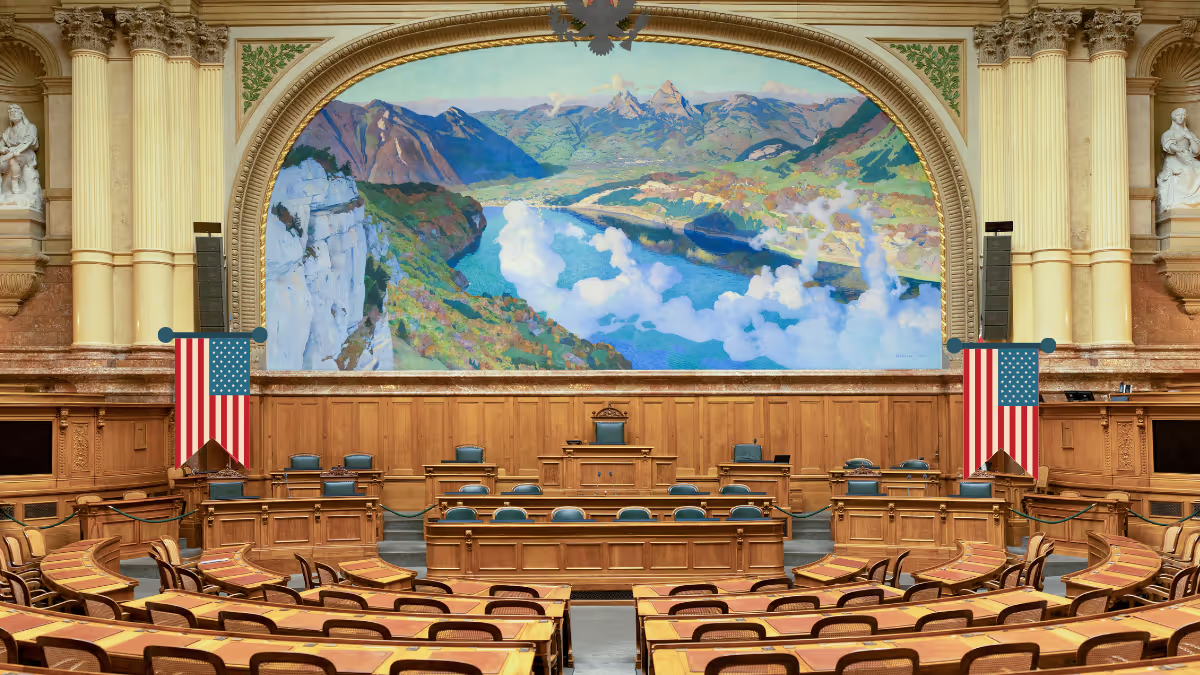
Project: The Parliamentary States of America
[This is the introduction piece to a project in which I'll be imagining the United States as if it were a parliamentary as opposed to presidential system. As the series progresses I'll link it's parts here. This intro will layout the basic rules of the project as well as describe why I think this project has use.]
What if America was a parliamentary democracy? American politics is dominated by its federal system, dividing the country into 50 separate quasi-states. These divisions, in turn, include smaller bodies: counties, cities, townships, districts, municipalities, and boroughs, each with their own governmental structures. At the top sit three separate, but equal, branches: the legislative, executive, and judicial branches. What separates the American presidential system from the parliamentary systems developed in Europe is the distinct separation between the executive and legislative branches. In a parliamentary system, the executive branch is formed from a group of politicians in parliament. This means that the executive branch may consist of several different parties in order to reach a majority, or even a single minority party which has enough allies to pass legislation.
The biggest advantage to a parliamentary system is its relative responsive simplicity. If the government is doing things that voters don’t like, it’s very easy for them to vote for the opposition in the next election. America’s presidential system separates power into so many different hands, that it can be difficult for voters to know where to direct their dissatisfaction. This has come to mean that presidential elections have the most weight as voters attempt to cast their level of satisfaction on the one office in which they can all cast a ballot. Don’t like what the government is doing? Vote in a new president, even if they hold less power than commonly presumed.
The separation of powers makes government more cumbersome and unwieldy. This was partially the point. The constitutional convention in 1787 was very concerned with concentrations of power and the founders were fearful of what they considered tyranny of the majority. However, they also built a system that has worked for several centuries (granted those centuries were interspersed with a civil war that one could argue came about due to institutional constraints preventing peaceful resolution). But today, confidence in the three branches of American government is unsustainably low. According to Gallop, the approval rating of Congress was at or below 25% for nearly the entirety of the 2010s. President Trump left office with only 38% approval. The Supreme Court, the only unelected branch, has steadily lost approval since 2000, although they remain just above water. While the president is the easiest to rectify, as the American public did with the election of Joe Biden, the problem of congressional approval speaks to the deep dysfunction in American politics.
Congress, with it’s two chambers and mix of electoral schedules, is difficult to hold to account, at least all at once. That’s probably why voters consistently rank their individual congressperson higher than they do Congress. It’s difficult to see actual outputs from your electoral inputs when legislation gets caught up in committee, filibustered on the Senate floor (or more often threatened with a filibuster), or just plain passed by one chamber and left untouched by the other. No wonder Americans don’t approve of Congress, it rarely acts! It’s clear to see how Americans respond when they see legislation passed by the branch: they’ve hit a high watermark of 36% this past week after the passage of Covid relief bills that directly affect Americans over the last half year.
The beauty, or danger, of a parliamentary system is that they generally create working majorities. And, with the mandate of the people behind their election, they pass legislation and enact laws that they promised voters they would during the campaign. There are no added veto points. If voters then decide that those laws in practice weren't what they wanted in theory, they can decide to vote in a new majority the next go around. However, parliamentary systems can also be caught in the similar stilted two-party system that dominates American politics, particularly if they use a first-past-the-post system.
First-past-the-post (FPTP) is a type of election that takes place within a defined geographic district that require the winner to receive a majority (or in some cases plurality) of the vote share. While this system leads to a greater sense of local representation it also makes it difficult for smaller or more issue oriented parties from gaining any representation in the legislative assembly. If a district has five candidates running from separate parties, only one party is ultimately going to be represented in that district even if the other four parties made up a majority of the voters. The 2019 United Kingdom general election is illustrative of this point.
In 2019 the UK Conservative party won a clear majority getting 365 seats in the House of Commons giving them 56% of all seats in that chamber. However, their percentage of the vote share was only 42% of the electorate. Likewise, the second place Labour party won 40% of the seats in the Commons with only 32% of the vote. But perhaps the most clear example of the weighting effects of a FPTP system were with the Scottish National Party (SNP) and the Liberal Democrats. The SNP won 48 seats in the Commons good for about 7% of the seats even though they won just under 4% of the votes. Meanwhile, the Lib Dems were on the opposite end of the equation, having won about 12% of the vote they only won less than 2% of the seats in the Commons.
Most parliamentary systems combat this lack of party representation by using some form of mixed-member proportional systems. These systems, as the name suggests, provide legislative districts with more than one representative and generally give voters the option to vote for the party as opposed to individual politicians. These systems can get quite complex in the ways in which they apportion seats, with model names like Loosemore-Hanby index, Webster/Sainte-laguë method, D’Hondt method, Hare quota, and Gallagher index. But these systems all have one goal in mind, to allow for the most proportional representation of political ideas and ideology in a political assembly as possible.
While proportional systems can take away an element of the constituent-representative relationship they also ensure that marginal voices receive some representation regardless of their geographic lonesomeness.
Congress as a parliament
To transform America into a parliamentary democracy would require answering a number of questions. Would this fictional scenario be retroactive? What would America look like if it had been a representative parliamentary democracy from the start? While interesting, there are too many unknowns in that scenario and, in order to keep some semblance of reality to this scenario, I’m going to pretend as if this system sprung out in 2021 replacing the presidential system we’ve had since 1789.
What about the Constitution? Remaking American democracy would necessitate a change to the founding document which is messy and complicated. For our situation, we will pretend that those difficulties were overcome, and a broad amendment to our current constitution was established giving us this exciting new form of representation.
Does the new parliament maintain its two chambers of the House of Representatives and the Senate? For our purposes, yes. Much as the UK has a House of Commons and a House of Lords I think this scenario will maintain our bicameral setup, choosing to change how members are elected as opposed to where members are elected. Furthermore, the Senate provides an interesting anti-democratic balance to this scenario (and reality) which will interact differently with the presumably much more ideologically diverse House. Here, the Senate will still contain 100 members equally representing all 50 states. However, much as the Commons forms the government so too will our House of Representatives be in charge of forming the new American executive branch.
I’m going to maintain the member composition of each branch because it gives us real life examples of politicians who I believe would fit in with our made-up or expanded parties. This means that I won’t be assigning different politicians to Senate seats, those who hold them now will hold them at the start of this series. Obviously this would be different were our electoral reforms to actually have taken place prior to the 2020 election, but we are going to pretend that the new system of government was enacted upon the swearing in of Congress in January 2021.
This also means that President Biden will be serving in a different role than that of the past 45 American presidents. As in other parliamentary systems, the president will instead act in the role that a monarch does for parliamentary monarchies (albeit, still elected every 4 years). Biden will serve in the role of asking politicians to make a new government and will represent America on the world stage and operate as a “father” of the nation. A role you could argue was tailor made for the Joe Biden we are witnessing thus far in his presidency. While our hypothetical Biden will not be able to veto laws, make rules, or overtly shape policy, he will provide a guiding voice for the next government and will undoubtedly give the first chance at forming a government to his old party the Democrats.
The judiciary will remain mostly untouched. In this scenario we’ve already altered the constitution so for the sake of this experiment the Supreme Court will maintain its authority but will not be able to declare the new system unconstitutional. In fact, we will strip back much of the authority of judicial review for federal actions. The Supreme Court will still be able to decide on state matters which disrupt the constitution but will not be allowed to strike down, whole cloth, the legislation coming out of our new parliament. Why? Because we are aiming to create a more representative democracy and the Supreme Court as it’s composed now is more of a divine council than a representative body. Lifetime appointments from presidents who need not win a majority of the electorate and approved by a body that strays far from proportional representation is not democratic. This scenario pushes the Supreme Court back to it's more constitutional origins.
If the Senate remains untouched as a body, how will the House of Representatives change? Here comes the representative path in our parliamentary experiment. Because I don’t want to throw out the federal nature of our American democracy I want to keep representatives tethered to states. But, I also want to provide the represent nature of mixed-member proportional systems. All while maintaining the same 435 members that it currently contains. This has an added layer of difficulty because particular, low population states have only one single representative (North Dakota, South Dakota, Montana, Wyoming, Delaware, and Alaska) making it difficult to adequately represent the full breadth of constituents in those states.
Now, because I’m maintaining the currently elected legislature as it is now it will be difficult for me to choose one of the systems that provide for proportionality because they do so after the election in order to give as close to proportional representation for each party as possible. So this is a problem that I’m going to solve as we move down the line of this project.
How I’ll proceed
I want to turn this into a longer project because I think there is value in imagining the possible. Much of the stagnancy in American democracy is that we are stuck thinking in the paradigms built over generations of a constitutionalized system that produced two parties. The actual work that it would take to radically overhaul American democracy and create a parliamentary system is immense, and that scale alone is enough to stop a thought experiment before it has even begun. But if we never think about the possible then we necessarily limit ourselves to the probable. The first step to crafting a new America is imagining potential Americas. Those of us who are interested in institutional changes often times look to the examples provided by other successful democracies around the world, but placing our thinking inside the current confines of American partisanship provides for more immediacy to our thinking.
This project will start by laying out some potential new parties. I’ll go one by one, starting with the Democratic and Republican parties. In this scenario, neither go completely away. Instead, these parties adapt to their more competitive environments. After covering the parties we know, I’m going to go about crafting new parties based on the people in Congress as of today. This process will also reshape a couple of already existing 3rd parties (The Libertarian party and the Green party). And following that I will explore potential parties which I don’t see represented in the current makeup of either major party. After laying out parties, I will delve into the dynamics that would make up our new multi-party democracy. How would a new government be formed? Who would be prime minister? What would the opposition look like? How would members of the opposition position themselves to show the electorate that they deserve to form the next government?
Parliamentary intrigue is often more interesting than Congressional intrigue because the stakes are more real. In our current iteration of Congress, parliamentary performativity is more important than legislating. Being successful on social media or garnering traditional media attention is better for a politician's electoral success than supporting their party or enacting real legislation. Parliamentary parties have to make real electoral decisions because laws will be passed regardless of the makeup of the chamber.
So buckle up! I’m not sure how long this project will last but I aim to push it for as long as I have ideas about what this alternative version of the United States would look like. Fantasy opens the mind up to new world; utopian thinking allows us to visualize our world in ways we could never imagine if we allowed ourselves to be constrained.