
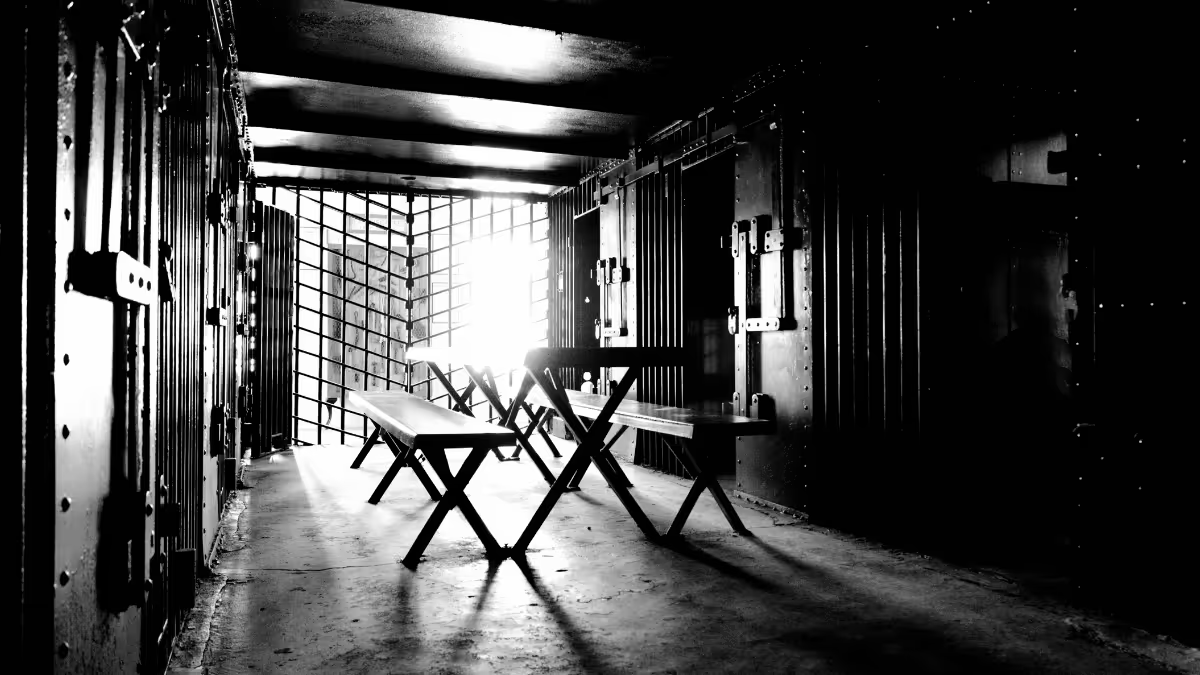
Second class citizenship and governmental responsibility.
What good is a state that does not protect its citizens? That’s the question I find myself asking as the Danish government refuses to repatriate 19 Danish children held in two prison camps in Northern Syria.
The Social Democrat led Danish government claims that they cannot bring the children home because their parents are a terrorist threats. They say bringing the children home would necessarily allow the parents to come with. Similarly, some members of the party also claim that they are powerless as the children are being held outside of Danish borders.
The threat of terrorism is a real. Danish authorities have been proactive in the last 20 years making a number of pre-emptive arrests of suspected terrorists and those believed to be plotting terroristic acts. And in 2015 a gunman opened fire on a “freedom of speech” event at a Copenhagen café, killing one and injuring two others before being gunned-down by police. Western governments have been particularly on guard following the influx of mainly Syrian refugees who fled the decade long civil war in their country in the 2010s. The influx also worked to the advantage of far-right xenophobic and Islamophobic political parties who stoked fear that asylum seekers fleeing war were actually an army bent on destroy Western, Christian, white Europe.
The same political forces that fight back against what they label an invasion in many respects hold a level of responsibility in the difficulty many immigrants and refugees from the Middle East and elsewhere have in integrating into their new home countries. This has led some researchers to raise alarm at the exclusionary or discriminatory practices used in some European countries as actually being more likely to raise the likelihood of Islamic extremism in the long term. It's an analysis that the Danish Center for Terror Analysis echoed in their own annual report in 2020. The report specifically points out that the children are not terrorism threats but that their prolonged stay in Syrian prison camps could contribute to future radicalizing.
The longer Denmark waits to retrieve their own citizens the more likely they are to create the sort of radicalized threats they claim to be trying to avoid. These children, being Danish citizens, have every right to return home at some point. The government can either decide that the time is now, or they can wait for the children to grow older, more resentful, more angry, before they return to their homeland. The answer from a security perspective seems startlingly clear.
The government claims that the children, while not being terror threats to the state, cannot be retrieved because their parents are terror threats to the state. They further claim that the children are not at fault but because their parents have ‘turned their back on Denmark’ there is nothing the state can do for the children. How this doesn’t raise the concern of every Danish citizen I don't know. If the state can arbitrarily decide that some citizens are no longer afforded protections from the state, what is to stop them from doing so again in the future? Besides the humanitarian bankruptcy behind the decision is also a deep indictment of the power and position of the Danish state.
Powerlessness is what you make of it
States may lack the authority outside their borders that they maintain within, but to suggest that states are completely powerless in international relations displays startling ignorance. Particularly for a state with as much social and economic power as Denmark. If Denmark was determined to retrieve its own citizens they could work with the Assad regime to make a deal. This is particularly true after Denmark decided that Syria was now stable enough to begin revoking refugee residency permits and sending them back to their home country. And doubly true considering suggestions by the largest opposition party to open cooperation with the Assad regime in returning asylum seekers who had their applications denied. If Denmark can negotiate with the Assad regime on returning asylum seekers they can certainly negotiate the return of their own citizens.
Denmark is not alone in its unwillingness to protect its own citizens, 57 states in all have yet to find a solution to repatriation. The situation that developed in the Islamic State was troubling for global conceptions of nationalism and statehood. To witness a radical, violent movement transform into a radical, violent self-proclaimed state was incredible for our 21st century idea of statehood and borders. The aftermath of the movement's physical crumbing left many states wondering what to do with citizens who left to proclaim loyalty to another state. While I certainly don’t envy the policy maker who must navigate this issue, the path towards resolution is clear. States must repatriate their citizens, children and parents together, and use their legal systems as they are constructed to meter out justice. States not only have a responsibility to their citizens to protect them but also a responsibility to maintain the law. By abdicating responsibility in retrieving and putting their citizens through the legal system, states like Denmark are abrogating their responsibility to lawless jurisdictions like the Assad regime.
I’m in no way advocating for the actions of those who left their countries to fight for the Islamic State, however we must be careful not to use the creation of stateless persons as a solution to actual trial and punishment. The future stability of Syria will not be helped by an increase in formerly European, now stateless persons. Children should never be punished for the sins of their parents.
Internal politics over state responsibility
Unfortunately this issue falls into politically contentious territory in Denmark. Immigration and integration have been political kingmakers in the past two election cycles. In 2015, a right-wing majority swept to power on the back of a historic increase of seats from Dansk Folkeparti (Danish people’s party) and in 2019 the Social Democrats were able to win back control of parliament by pivoting hard to the right on matters of immigration. Clearly this case should have nothing to do with immigration or integration, these children and their parents are Danish citizens after all. But that hasn’t stopped the parties from using their immigration spokespeople to talk about the matter with the media. Which speaks to a broader concern in Danish politics, is the prevailing mood of Danish politics one of ethno and religious nationalism?
Cases like this one unfortunately speak to that end. Had these children been dragged off to fight for a failed Christian state in the heart of Wyoming, I doubt the Danish government would be so hesitant in repatriation. The government is stuck between the rock of their responsibilities to their citizens and the hard place of racialized, cultural identity voters. Any party that dares to make immigration law easier will lose the support of a not insignificant portion of the voting electorate.
I’m probably more sympathetic to the difficulties of electoral politics than a rational person should be, but in this case I think the normative negatives far outweigh the political positives. Not fighting for your citizens sets a damnable example that the state can no longer be trusted to protect its own. Regardless of the political cost, it is imperative that governments maintain the importance of the state and its legitimacy, over their own ability to win elections.
Public opinion and the battle for political will
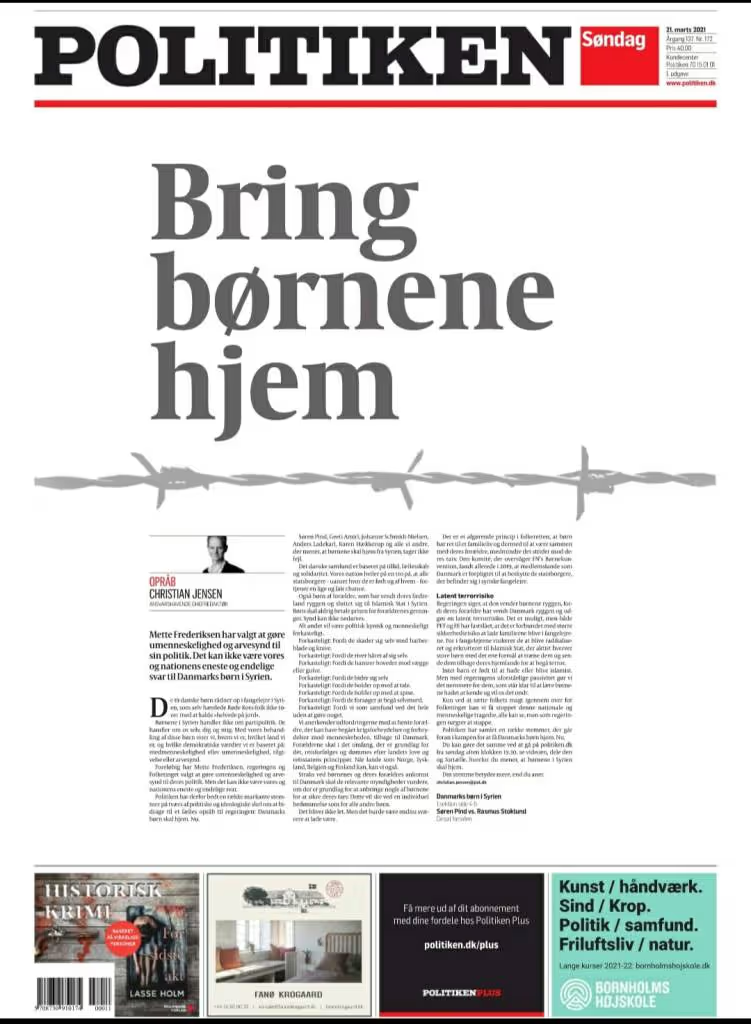
In the long run, I’m not sure how much my legitimacy concerns will actually affect Danish politicians or voters more generally. This case has been several years in the making and the government continues to stand fast in their weak reasoning on why they won’t bring their own children home. However, opinions can change quickly. On Sunday, the newspaper Politiken dedicated their entire front page to their editorial board’s demand that the children be brought home immediately. They also produced a video including current and former politicians across the political spectrum demanding that the government bring back the children. Furthermore, and perhaps more importantly, public opinion appears to be shifting. While polling from earlier this month indicated that 49% of respondents were against bringing the children to Denmark with only 34% for it, polling that took place the following week showed 50% of respondents thought that Denmark should bring the children home.
It’s difficult to get an accurate reason for such large polling discrepancy but more than anything I think it shows the Danish opinion is not nearly as solidified as the parties seem to think. It’s possible that opinion begins to swing as concerted persuasion efforts continue. Just this week the leader of Liberale Alliance (a libertarian leaning party) signaled his change of heart on the matter arguing that the government needs to bring the children home, albeit without their mothers. Public opinion can change quickly as subjects take the media spotlight. The Social Democrats have shown a political cunning and understanding of hewing to political salient messaging, never straying too far out on a political limb. If public opinion swings towards repatriation I’d expect them to act quickly in changing their positions, particularly as they’ve struggled to make a strong case for why they aren’t acting now.
Denmark isn’t alone in having to handle these politically sensitive cases. Western Europe more broadly is faced with a multicultural future and how European democracy fits into that equation. Will states rise to the challenge of confronting anti-democratic nationalistic parties or will they continue to appease those voters with capricious and restrictive immigration laws? Can European states forge a creedal identity where membership in the polity is built on shared cultural and valuative identities? Or will European identity be tied to ethno-nationalist exclusivity? If Denmark continues to deny their duty as a state to protect and judge their own citizens, I fear it will be affirmatively answering the latter.