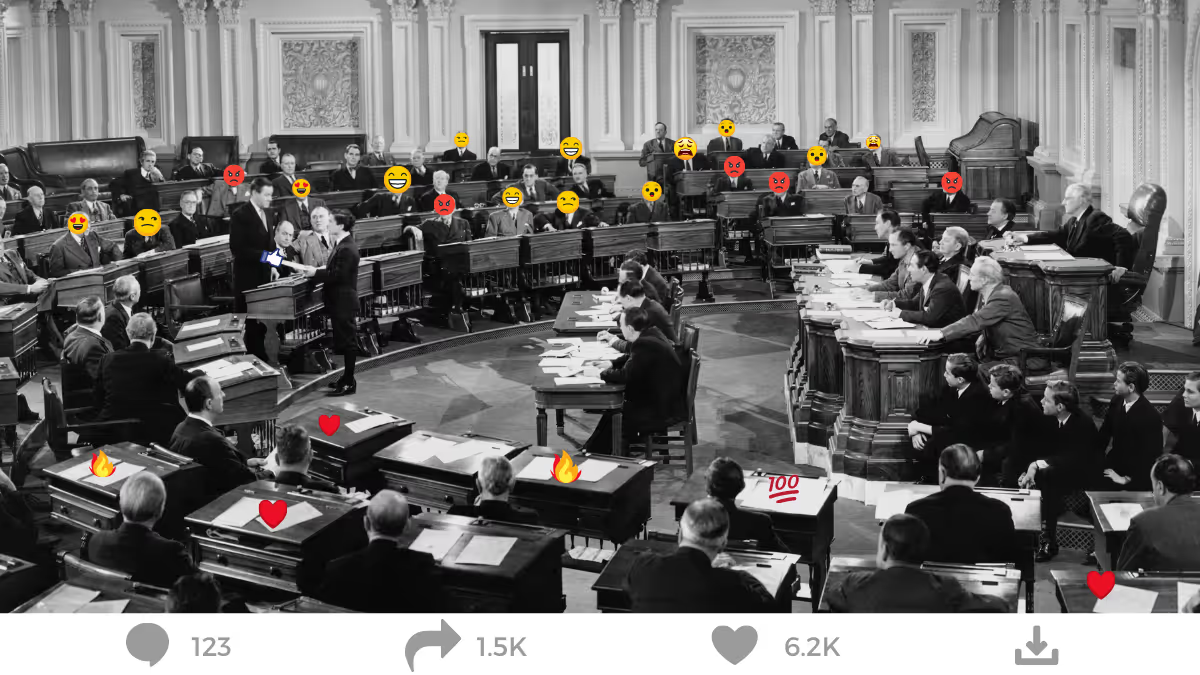
Social media's algorithm of engagement as political strategy.
The presidency of Donald Trump exposed a number of uncomfortable realities for American politics. His emergence into politics using ‘birtherism’ to question President Obama’s legitimacy and his racist attack on Mexicans during his campaign announcement were later supplemented by a whole host of raw racist, xenophobic, sexist, and rude commentary. For most on the American left, President Trump was the dirty roots of American opinion laid bare for everyone to see. For those on the right, President Trump was the first politician in decades to speak like the common man and extoll ‘common sense’ opinions. But even some who had worked for years in promoting Republican and conservative causes were disgusted by what they saw in Trump the man. Furthermore, Trump’s time in office included the bending and breaking of institutional and normative branches which had long held aloft the American democratic nest. His constant lies and misstatements further solidified an America with two epistemic models, two different realities, two separate definitions of facts and truth.
It’s difficult to write about the dramatic shifts that took place on account of the Trump presidency. For some, his presidency was just the symptom of deeper American ills. For others, he was an aberration, elevated by unlikely circumstances and twists of unfortunate fate. Both can be true. Trump certainly represented a side of American political thinking which had clung on the underbelly of partisan politics, but he also made his way to the presidency through a series of unlikely events with a host of opportunities which could have prevented his rise. The latter point is perhaps just as supportive of the former. American institutions have been weakened to the extent that inactivity at partisan electoral nodes (the party never stepped in to stop a candidate it did not initially support) led to the misfiring of another preventative electoral node (the electoral college electing Trump whereas it at one point would have thoroughly defeated someone with so little resumé for the job).
But the influence of the Trump presidency that is most interesting, and maybe the most uniquely his to claim, is the creation of the social media politician. Obviously President Trump used Twitter extensively in not only creating a pre-election following, but in messaging directly to the people even after he took office. His tweets could direct the news cycle and often would drown out any other bit of news, important or not. Some even postulated that he used his power of the digital pulpit to redirect attention away from scandals in his administration as if he were playing 4d chess. No singular person has ever had such a powerful and extensive messaging tool. Trump was not the first Twitter president, Obama had used the platform in a far more traditional manner, sending out political messaging that were more akin to press memos or campaign speeches. But Trump used Twitter in the way most social media users do, to provide a stream of personal consciousness packed to the character count with emotional appeals, angry missives, brutal attacks, and proudly supportive statements.
Trump used social media in the way in which social media companies want their products to be used. He drove eyeballs to his tweets because he appealed to conflict and emotion. Strong emotion drives engagement and thereby is spread further by algorithms built to reward interaction, regardless of the value of the content therein. Those lessons were well learned by other aspiring politicians. The 2020 election, while seeing the loss of Donald Trump, saw the election of several mini-Trumps, at least in terms of their social media-esque habits. Rep. Marjorie Taylor Green (GA-14) and Rep. Lauren Boebert (CO-3) both won office in non-competitive districts by parlaying outrage to votes. They joined Rep. Matt Gaetz (FL-1) and Rep. Jim Jordan (OH-4) as congressional fire throwers, who have adapted the same forms of social media-esque engagement on the House floor.
Politicians and the algorithms of engagement
The role of a politician is really that of a public servant. In the ideal telling, politicians run for, and win office, with the goal of serving their constituents by drafting, amending, passing, or preventing legislation that will help their constituents. The best representative is one that fights for the issues that are most important in their district. Unfortunately, the nationalization of politics and the gutting of local news has left many local constituencies without information or genuine concern about more local issues. Instead of a representative needing to explain to her district why she was unable to pass funding to update a water treatment plant, she needs to explain why she voted for a bill that the opposite political party also voted for. This is increasingly true as congressional districts become less and less competitive. Most representatives need to appeal to the most ideologically extreme members of their local base because the results of the partisan primary is the only competitive election they will face.
A politician is at the whims of their constituents' national media diet. As the revenue model for local news has lost power and the ease with which national news can be read from the palm of your hand, politicians have fewer incentives to fight for local issues. Between 2008 and 2018 advertising revenue for local newspapers has decreased by 68%. This corresponds with around 1,800 newspapers shutting down between 2004 and 2018. News deserts not only leave local communities without reliable journalism but it also deprives local lawmakers of accountability. No national newspaper is going to investigate how much an individual politician’s legislative priorities have affected their district, unless it relates to some higher level story.
Much of the decline of local news has corresponded with the rise of social media. Not only have Google and Facebook sucked all the oxygen out of the advertising market, but Facebook in particular has also sucked up local “news.” As of 2018, over half of Americans say they get their news from social media. At the same time 52% of American Facebook users say they get news from the platform. Because these platforms collect user data in order to specifically tailor advertisements to each user, they are also a more effective place for businesses to advertise than in the pages of their local broadside.
Social media doesn’t only provide selective promotions of particular news stories, it also encourages a form of citizen journalism. Rumor mongering and the spreading of misleading information is old as society itself, but the use of social media has enabled everyone to partake from the comfort of their own couch. In the place of local news come Facebook groups designed for particular towns, communities, or even neighborhoods. These groups have filled in the gaps left by gutted local news rooms. However, they’ve also served as vehicles for misinformation and disinformation. The ability for anyone to post not only provides a level of trust, these are your neighbors after all, but also a lack of accountability which would come from a newsroom filled with trained journalists and editors.
This form of local journalism leaves a lot to be desired. The journalistic integrity ingrained in local news rooms is lost when concerned citizens decide to write the stories themselves. Particularly in an America torn by partisan polarization. Colloquially, my hometown’s Facebook group has experienced such fierce partisanship that competing groups have been established, thereby siloing local community members further apart (thankfully we still have a twice weekly newspaper). As Americans continue to segregate themselves into increasingly confused and distinct information bubbles they exacerbate America’s biggest democratic threat: partisanship.
Partisanship and the creation of the social media politician
America’s political landscape is torn between two competing parties. As it’s been since more or less the start of the republic. However, the heightened tension between the two parties has reached such a peak that any bi-partisanship is seen as pushing your fellow climbers off the summit. The way to win elections and keep power is to never give in and never give the other party any victories. This means that bipartisanship must either be too quiet to elicit reactions from partisan media and activists, or be viewed as so necessary that bipartisanship no longer carries a negative weight among base actors (e.g. Covid stimulus during the Trump administration).
Americans say they want bipartisanship, but almost never reward politicians for trying their hand at it. So politicians looking to keep their jobs will continue to behave as partisan actors, regardless of what Americans say they want. The reality is that Americans increasingly vote against the party they hate instead of voting for the party they like. This phenomenon has been labeled as affective or negative polarization and has enough political science research to justify viewing American politics through this confrontational lens. It also portends to a shift in political messaging. If your voters aren’t really voting for you but instead are voting against your opponent then leaning into negative messaging is an effective way to win elections.
Few politicians were more effective at this route than Donald Trump. His platform was ideologically confused, bucked a number of conservative priorities, while emphasizing particular cultural grievances. While his government ended up being a relatively straight forward ideologically conservative government, his style and messaging never walked hand in hand with Republican orthodoxy. Instead, Trump was able to tell his voters what they didn’t want. They didn’t want more immigration from Mexico, they didn’t want Muslims in the United States, they didn’t want experts telling them what to do, they didn’t want coastal elites deciding what they could and couldn’t say, and they absolutely didn’t want Hillary Clinton to be their president. Trump took affective campaigning to its maximum, he was a blank slate which they could cast their policy aspirations upon and a fighter who was going to turn back all that they knew they didn’t want.
Trump didn’t need to deliver on policy goals because he was the culture warrior that the Republican voter base desired. His combative, built for social-media-engagement, style of messaging fit perfectly with an electorate that feels its losing the war on American culture. The Republican party feels like it’s losing cultural power and the Democratic party feels it is losing political power.
Other politicians have taken note. It’s more important to look like a fighter and sound like a fighter than it is to actually fight for legislation. Matt Gaetz of Florida in his first four years in office sponsored only two bills that have even reached committee. Neither have become law and only one has passed in the House. Meanwhile, Gaetz has appeared on Fox News over 170 times. Jim Jordan has been in congress since 2007 but has only sponsored two bills which have made it to committee, neither became law. Jordan also makes nearly weekly live appearances on Fox.
Newly elected conspiracy theorist and Georgia Representative Marjorie Taylor Greene has been far more active than her stylistic forebearers, she’s already sponsored six bills in her short time in office, but a closer look at the content belies a similar theme. Of the six bills introduced, only three include actual text. Two of which are anti-gun control measures and the third being the impeachment of Joe Biden introduced on the second day of his term. Of the remaining three, it's clear Taylor Greene is using the ‘engagement’ model of legislating. For example:
“H.R.1883 - To enact a moratorium on immigration, build the wall, prioritize securing the Southern border, repeal certain executive orders which endanger the security of the United States, re-assert a zero-tolerance immigration policy, ensure the safe return of unaccompanied alien children, reduce human trafficking, deport criminal aliens, and end chain migration.”
Feels more aspirational than actual substantive policy, and considering it doesn’t actually include text, it is really nothing more than a tweeting in bill form. The role of the legislator has become muddied with the role of campaigner. Increased exposure means greater name recognition means greater chance at future success for higher office.
Social media or the perpetual campaign?
To a certain extent, the problem in American politics isn’t just that politicians have internalized the algorithm-of-engagement as a form of politicking, it’s that politicians are constantly campaigning. To campaign and to legislate are two separate jobs. Some politicians are excellent campaigners but only so-so legislators, others may be lackluster campaigners but excellent legislators. Unfortunately, the best legislators are not always the best campaigners. Much in the same way that an interviewee for a job may be an excellent interview but not actually that great at the job they are interviewing for. They may get the job over someone who would have done a much better job but just wasn’t as talented an interviewee.
Because the political cycle has become constantly about the next election (see the already begun 2024 coverage). It means that elected officials must think about the electoral implications of their action at every turn. This is what drives partisans away from bipartisanship. The adoption of an algorithm-of-engagement style politics is the adoption of a successful strategy from one area of business to another. Facebook and Twitter know how to keep eyeballs on their platforms. Politicians are learning that they can use the same strategy to keep donations coming in and voters excited.
Unless the incentive structures around partisanship change, expect to see more, not fewer politicians, utilizing the algorithm-of-engagement. As fewer politicians need to worry about campaigning outside their base, passing legislation, or building an affirmative platform in order to win elections, politicians have every reason to adopt the algorithm-of-engagement style. Political analysts and news outlets decry the substanceless nature of these politicians but fail to recognize the success that it garners and the emulation that it entails.
Can we really blame politicians for acting this way? It’s not an illogical response to the hands they are dealt. If winning elections is the most important aspect of being an elected politician then why wouldn’t they seek to do whatever puts them in the best position to do so? While it may feel cathartic to condemn politicians who engage in outrage and emotion without offering any substance it doesn’t actually go to the root of the problem. Just as in any system, there will be those who take advantage of the flaws. So too in our political system are there politicians willing to take advantage of the deep structural problems built into our system. Until we face the roots of polarization and the anti-democratic elements of our system, we will continue to see politicians like Trump, Gaetz, Jordan, and Greene.
Political problems require political solutions. Congress has taken the habit of dragging the heads of the tech industry before committees and using the time to berate and question. However, it has yet to actually act on those hearings, no major legislation curtailing the power of big tech has so much as sniffed the chamber floors. Congressional politicians have used big tech to bolster their audience in the same way big tech has taken advantage of their users to drive advertising revenue. As long as we allow outrage to drive our behavior, whether it be online or at the ballot box, actors will continue to use the algorithm-of-engagement to get our attention. We may not like the supremacy of emotion and outrage but we’ll continue to click, and vote, anyway.